
Your Agency Dashboard is Worthless.

Problem: every major consumer brand has already done the basic Amazon work. Their catalog is pretty clean. Detail page content looks good. They have a defensible ad strategy. They have a competent team managing Amazon, and they’ve probably gotten help from several agencies along the way. And it seems easier than ever to maintain that work with cheap tools and AI.
What’s left? For established brands, the remaining Amazon growth is almost entirely financial and strategic. Negotiating vendor terms to slow the growth of contra-COGS. Identifying which Amazon programs actually move the needle versus which ones just move money from your P&L to Amazon's. Deciding which country to launch in or divest from. Understanding which products are dragging down Net PPM, CM, and your own profits. Whether the cause is a fixable distribution problem, a structural cost issue, or even an Amazon error. Finding shortage claims and co-op billing errors before they compound. Knowing how Amazon is modeling your growth before they walk into AVN, so your team can either validate or push back with data.
These opportunities are real and worth millions. They're also opaque to many agencies, because their tools are focused on retail sell-through and ad optimization, where most account managers and SOPs are comfortable.
The agencies using Reason are doing things their competitors can't. They're validating client PPM independently using actual co-op deductions, and finding discrepancies that change entire negotiation strategies. They're building shortage claim recovery programs in-house instead of routing clients to the same five white-label recovery vendors everyone else uses. They're walking into AVN prep sessions with a complete picture of Amazon's forecast accuracy by product, the client's co-op ROI by program, and a quantified list of operational issues with revenue impact attached. They’re building omnichannel IP using our data infrastructure.
Most importantly, they’re keeping clients and growing revenue. Not worrying about AI displacement or looking for a buyer.
Commoditization is Real
Here's the uncomfortable trend for agencies: the basic work is getting harder to defend. Catalog management, content optimization, ad management, search strategy -- these are becoming table stakes that brands can increasingly access through cheaper channels, AI tools, or internal teams. The agency value prop built around those capabilities is pressured in ways that weren't true five years ago. Brands aren't just asking "what have you done for me lately?" Now they compare your answer to promises made by LLM influencers and vibe code platforms, and they compare your fee to a $200/mo Claude Max subscription.
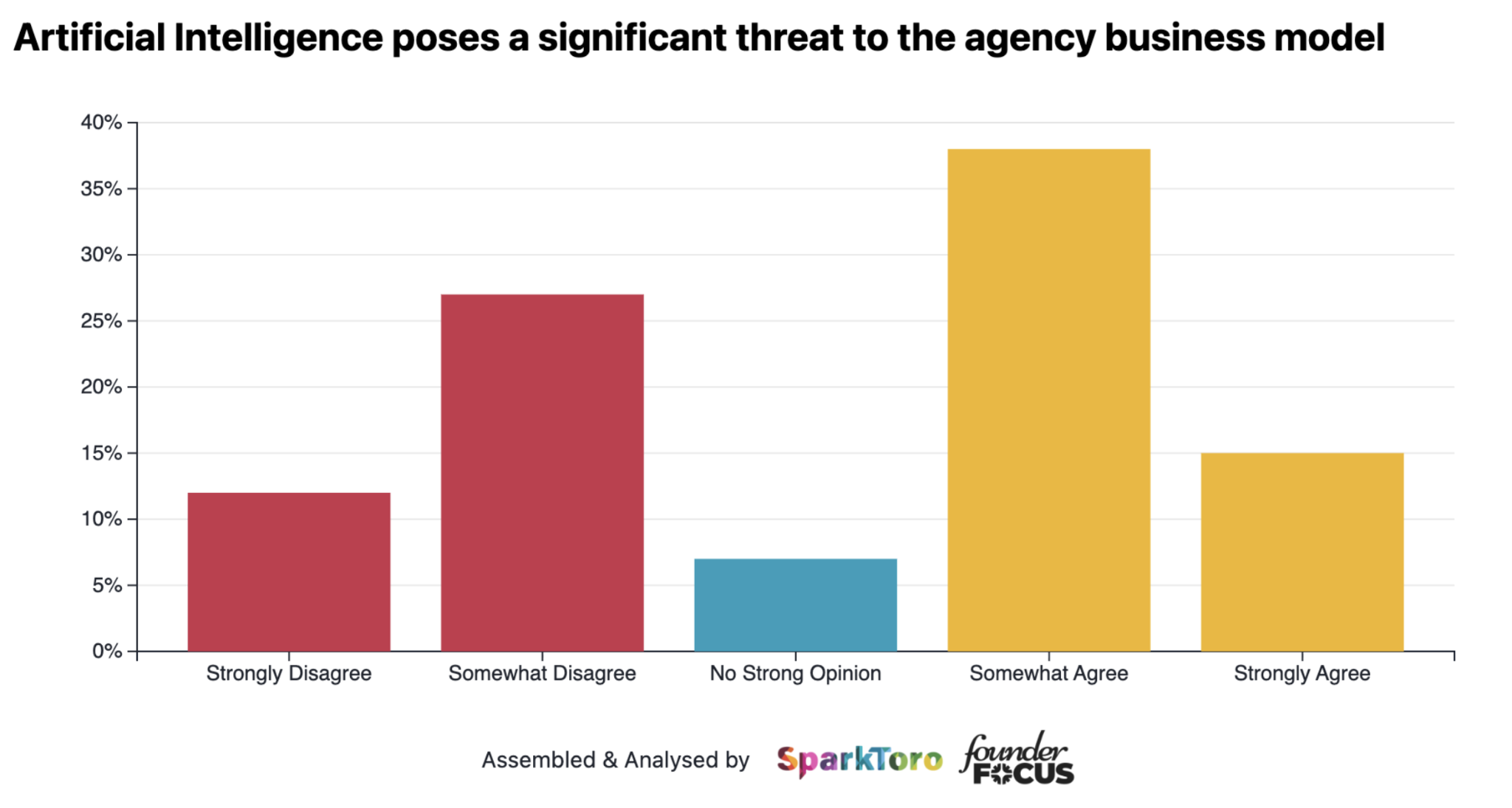
53% of agencies view AI as a significant threat to their business, and that number keeps growing. But the same survey showed that 40% do not -- and the reason matters. The confident 40% aren't AI skeptics. Their long-term value was already shifting from doing the work to strategically managing the work through AI-driven automation and observability. Build playbooks and SOPs that let lower-cost team members replicate successful strategies. Have leaders audit results, improve systems, and own the client narrative. For agencies already operating this way, AI is rocket fuel. But staying ahead requires something the agency model hasn't traditionally prioritized: equipping your account managers and analysts -- not just your clients -- with tools that support key strategic moments and make genuinely new analysis possible.
“Today’s judgement will become tomorrow’s intelligence. As AI systems accumulate proprietary data about what good judgement looks like in their domain, the frontier will shift. Copilots and autopilots will converge. The copilot-to-autopilot transition has already begun in several categories. But the starting position matters because it determines where autopilots can win customers now and begin compounding the data that will eventually let them handle judgement too.”
- Julien Bek, Sequoia Capital, “Services: The New Software.”
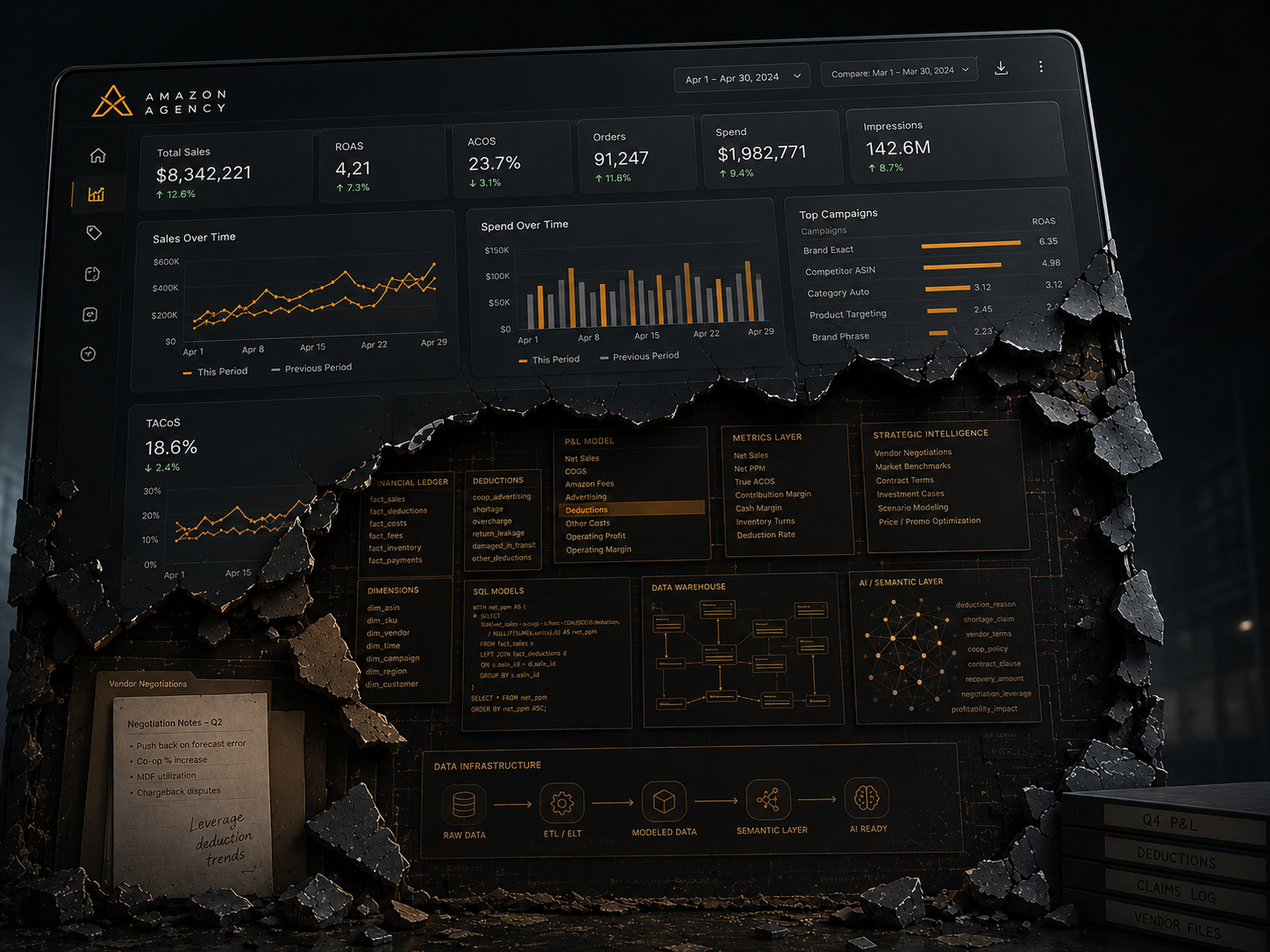
Dashboard Value Hit a Plateau Years Ago
Leaders know that even the best dashboards only address 50-70% of the client’s needs. Yet most agency analytics tools are client-facing: a reporting dashboard that replaces or enhances weekly reports from the account manager. Focused on sales and advertising performance, these tools made sense when the value of an agency was easily attributed to sales growth. “Your sales were growing at +30% YoY, and accelerated to +82% YoY after 6 months working with us.”
But that model breaks down when the easy/medium/hard growth is done. Proving value and incrementality becomes a subtler exercise: measuring improvement by product tranche or customer niche, driving profit growth instead of just sales, improving negotiation position and subjective relationship quality with Amazon. The value of your agency is the strategy, interpretation of results, and iteration based on harder-to-find signals. And that requires your account managers to have analytical depth and scenario planning that most dashboards can’t produce.
The specific gap is financial data. Virtually every agency already monitors sell-out trends, traffic, Amazon inventory levels, catalog health, ad performance, etc. That's the floor. The ceiling is using detailed P&L data, co-op agreements, deduction histories, payment records, and noisy ops notifications to generate recommendations that speak directly to how a brand should approach their next QBR, which programs to invest in, where their profitability math breaks down, and what they can credibly push back on in a negotiation.
That analysis is only possible if your analysts have access to the right data, tools to work with it, and context for interpreting the outputs. Most don't. Not because your team isn't capable, but because Amazon buries the information in a dozen different data sources that don’t talk to each other. The data infrastructure to support this analysis didn’t exist until we built it.
In the example below, our vendor P&L data models make it easy to validate Net PPM accuracy by replacing Retail Analytics contracogs estimates with actual deduction data, ASIN by ASIN:
Your Clients are Smarter and Expect More
Agencies aren’t the only ones learning and growing. Your brand clients are smarter and more sophisticated every year. With smart clients, there's a specific dynamic that exposes the limits of most analytics setups. A client asks: "What was our P&L on our top 20 ASINs in Q4?" Your team answers. The client says: "How do you know that number is accurate? How did you calculate profitability? What happens if we push back on Amazon's co-op allocation -- what does that do to the model?"
Those follow-up questions are the real test. They require not just data, but documented methodology, explainable logic, and the ability to run scenarios in real time. The brands asking those questions are your most valuable clients. Losing credibility with them is expensive.
That's a different infrastructure problem than "do we have a good dashboard." It's about whether your team has the underlying data quality, the analytical models, and the expert support to stand behind their work when it gets scrutinized.
Your account managers and analysts are smart. When they hit a wall on a data question -- a discrepancy they can't explain, a metric that doesn't add up, an API data quality issue -- they need a fast answer from someone who actually knows Amazon vendor data at a technical level. A 48-hour support ticket from an offshore tier-one team isn't going to cut it.
Supporting agency work is fundamentally different from supporting brand-side customers. The questions are more technical, the stakes are higher because a client is in the room, and you need deeper context to give a useful answer. When your senior analyst needs help, they need to talk to someone at least as knowledgeable as they are. That’s why Reason includes access to ex-Amazon retail and engineering leaders for all customers. We’re the invisible amplifier that helps your team build new billable capabilities, and give fast, confident insights that stand up to the “five whys.”
“They have gone above and beyond to ensure consistency, reliability, and integrity with our client-facing reports, allowing us to not misstep from a client service standpoint. That has led to some big customer wins that would not have been possible without their work.”
- Nate Hogle, Sr. Director, Program Development — MediaMonks
The Solution: Tech-Enabled Services
Y Combinator predicts that software-enabled service businesses are the future of agencies: firms that use proprietary data, AI agentic workflows, and software to create outcomes that neither humans nor AI can replicate alone, and drive millions in revenue per employee. Their thesis is the same as ours: AI continues to make top-tier humans more capable and valuable. Instincts forged by experience, combined with tech-enabled analytical speed, create increasingly scarce outcomes that clients will pay for.
That’s what we’re powering for Amazon agencies.
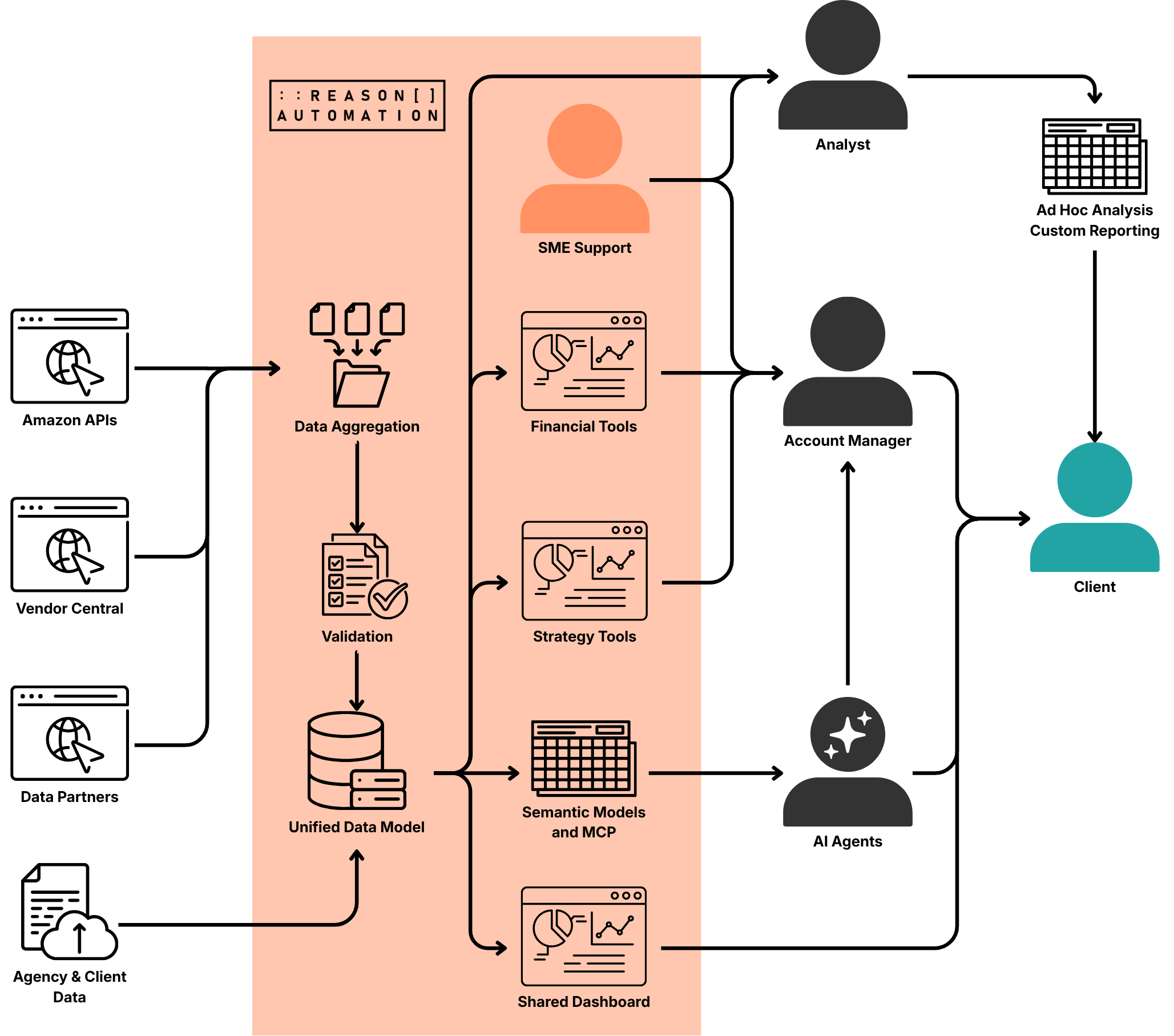
Reason has never been “just” data or analytics. We built the exact data environment that makes unique insights more feasible and faster, whether the endpoint is a dashboard, ad-hoc analysis in Excel, or a LLM. All built on a unified data model that keeps your team in sync and helps build client trust in their insights.
Financial and strategy tools that give your account managers the analytical depth to run scenarios, validate PPM, audit deductions, and build a negotiation case that holds up. A shared dashboard for client-facing reporting that's grounded in the same underlying data, so there's no gap between what you tell the client and what your analysts actually see. And a semantic model with MCP integration that makes the entire dataset queryable by AI agents, turning months of data engineering work into something your team can interrogate with a prompt.
The result: your analysts work faster and dig deeper. Your account managers walk into QBR with findings nobody else in the room has. Your AI investments produce outputs you can actually put in front of a client. And Reason experts are available when your team hits a question the tools can't answer alone.
“With your help, we limited Amazon’s margin gain and moved agreements to strategic areas. They reduced our base and removed our merch accrual, a huge win!
Reduced our base 1%
Removed our merch accrual (HUGE win)
Added a 35 bps damage agreement vs. actualized
Moved to a flex SnS agreement
We’re happy with the results and have Reason’s negotiation tools to thank.”
- VP Ecommerce, Global CPG Brand
The future agency doesn’t win because it manages ads or detail pages better; it wins because it understands the client’s Amazon business better than anyone else in the room and can translate messy data into decisions about pricing, programs, inventory, and negotiations. The winners are the ones that reoriented their value prop around financial expertise and strategic support, and built infrastructure to deliver it at scale. That’s the model we built Reason to support.